

Vienna did not get UNESCO recognition because someone decided its coffee was more important than everyone else’s. That would be ridiculous — and very not-UNESCO. It got recognized because the coffee house itself became a whole cultural operating system: a place where people read, argued, wrote, flirted, hid, worked, and very elegantly did absolutely nothing for a suspiciously long time. If the Italian bar is built for rhythm — espresso, two sips, ciao — the Viennese coffee house was built for settling in. And honestly, in an era of laptop limits, QR menus, and those subtle “we need the table back” vibes, that feels borderline rebellious.
That’s the real story behind how Viennese coffee house culture became a UNESCO heritage tradition. Not the whipped cream. Not the chandeliers. Not the postcard version of “European café elegance.” Austria made the case that this was a living social practice worth protecting: a way of being in public that shaped urban life for generations. Which, when you stop and think about it, is kind of amazing. The coffee house wasn’t treated as décor. It was treated as culture. Not a business category, but civic infrastructure with cake.
How Viennese Coffee House Culture Became a UNESCO Heritage Tradition
Here’s the part people mix up all the time: Viennese coffee house culture was added in 2011 to Austria’s national inventory of intangible cultural heritage, under the framework created by the UNESCO Convention for the Safeguarding of the Intangible Cultural Heritage. That convention, adopted in 2003, is about protecting living cultural practices — not just monuments, buildings, or beautiful old things sitting behind glass.
That distinction matters. A lot.
UNESCO World Heritage, the version most people know, is about places: cathedrals, archaeological sites, historic city centers. Intangible cultural heritage is something else entirely. It covers practices, rituals, knowledge, oral traditions, performing arts, craftsmanship, and social customs passed from one generation to the next. So the point was never, “Save this one lovely café with the pretty mirrors.” It was, “This repeated social ritual has value beyond commerce.”
That’s why the recognition focused on the whole experience: ordering coffee, being served a certain way, sitting for a long time, reading newspapers, meeting friends, writing notes, playing chess, discussing politics, or simply existing in public without being gently pushed toward the exit. You weren’t paying only for a beverage. You were stepping into a script — one Vienna had been refining for centuries.
One of the most quoted descriptions of the Viennese coffee house says it best: it is a place “where time and space are consumed, but only the coffee is found on the bill.” People repeat that line because it’s clever, sure, but also because it explains the whole logic better than a lot of academic language ever could. The actual commodity was never just the cup. It was everything the cup quietly allowed.
And that’s where the contrast with Italian coffee culture gets especially fun. If you want a sharper look at that faster ritual, see why counter coffee hits different in Italian bar culture.
In Italy, especially in classic bar culture, coffee often means tempo. You walk in, order an espresso, maybe stand at the counter, drink it quickly, exchange a few words, and carry on with your day. There’s choreography to it. Precision. Repetition. Tiny moments, done properly. Also yes, Italians have rules. Cappuccino after 11 a.m.? Bold choice. Espresso after lunch? Correct. Standing at the bar instead of occupying a table for one quick caffè? Efficient, elegant, and usually cheaper. It’s ritual too — just a different flavor of ritual.
Vienna’s heritage case was almost the mirror image. Not speed, but duration. Not turnover, but lingering. Not “have your coffee and continue,” but “have your coffee and remain.” UNESCO wasn’t rewarding a superior roast profile. It was recognizing a public ritual of slowness.
Which is kind of great, actually. Coffee as a protected form of hanging around.
The Real Secret Wasn’t Coffee. It Was Permission to Linger.
If you want the shortest answer to how Viennese coffee house culture became a UNESCO heritage tradition, here it is: it institutionalized something cities rarely give away freely — the right to linger.
That sounds minor until you realize how unusual it really is.
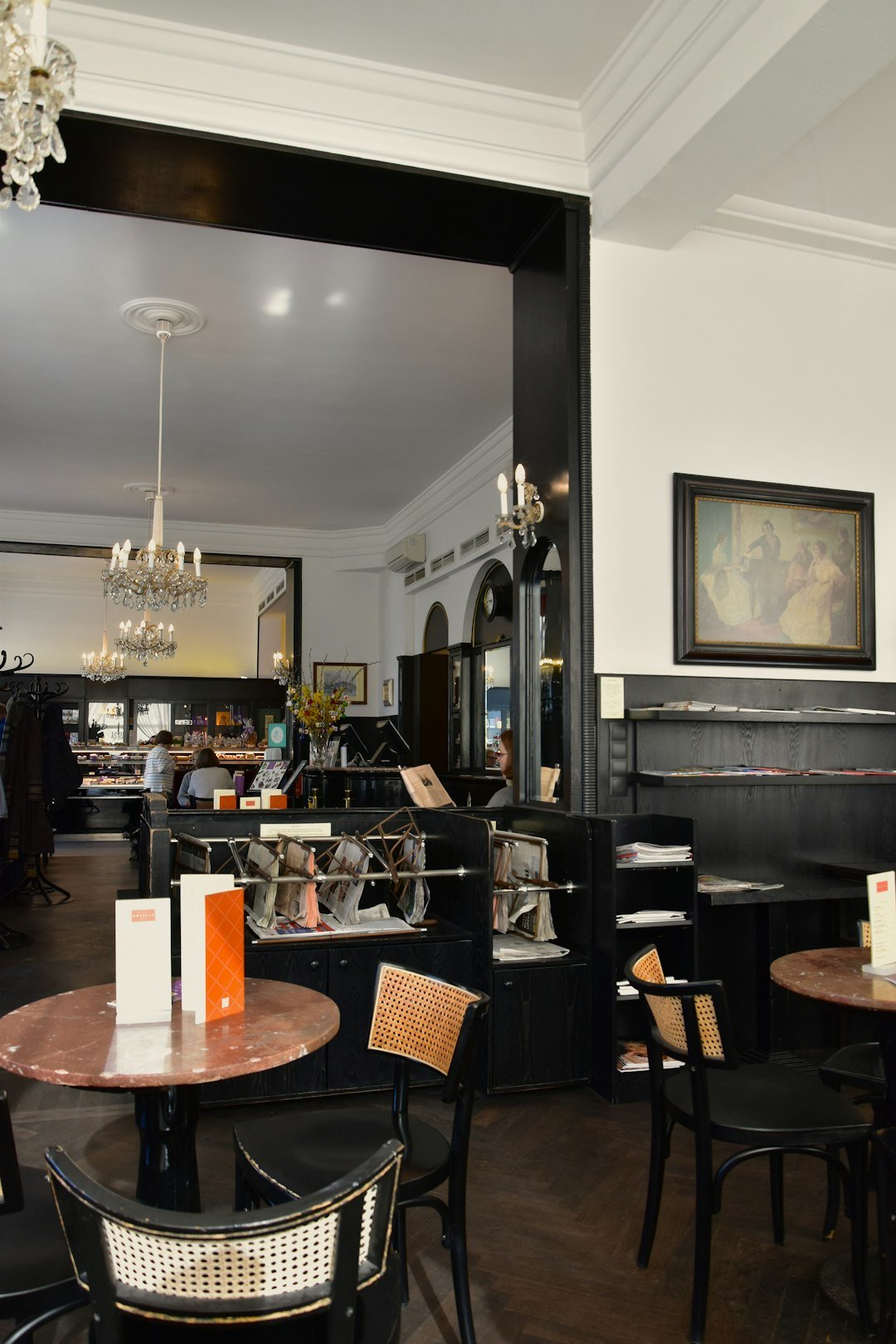
The classic Viennese coffee house was built for duration. Think marble tabletops, bentwood Thonet chairs, coat stands, upholstered benches, newspapers clipped onto wooden holders, proper table service, and rooms arranged so that idling looked civilized instead of suspicious. None of that was random. The furniture, the service rituals, the pacing — it all supported the same idea: you could stay.
You could sit alone and not be treated like a problem. That matters more than it gets credit for. In a lot of public places, being alone still carries this weird charge, as if you should either be waiting for someone, staring at a screen, or proving you belong there. In a Viennese café, solitude could be a perfectly respectable activity. Reading was enough. Thinking was enough. Looking out the window was enough. Honestly, that’s a luxury.
You could work there too, long before “working from cafés” became a full-blown aesthetic with TikTok lighting and productivity discourse. Writers did it, journalists did it, students did it, people with tiny apartments did it, and people who simply liked being in a room with ambient life did it. The coffee house worked as a semi-public living room. No membership. No app. No “community manager.” Just a seat, a coffee, and the shared understanding that time could stretch out a little.
Then there’s the water.
In many traditional Viennese coffee houses, coffee comes with a glass of water. That’s not just a decorative flourish. It changes the rhythm. Water extends the moment. It suggests pause. Sip the coffee, sip the water, read another page, continue the conversation. Tiny service details can carry huge cultural meaning, and this one absolutely does. One extra glass, and suddenly the whole thing feels less transactional.
By the late 19th and early 20th centuries, this setup mattered deeply in city life. Not everyone had spacious, warm, comfortable private rooms for reading, entertaining, or working. The café filled that gap. It offered warmth, light, company at a distance, and access to the city’s intellectual weather. You didn’t need to host a salon at home if the salon was effectively spread across café tables all over town.
Today we’d call that a third place — a social environment that’s neither home nor work. Sociologist Ray Oldenburg gave the concept its name much later, but Vienna had already been doing it in practice. The twist is that the Viennese version was gloriously low-tech. No algorithm. No notifications. No “engagement strategy.” Just ambient coexistence. You could participate actively or passively. Both counted. For a broader look at how cafés shape modern social space, read why the coffee shop experience matters in digital life.
That may be the most radical part of all. The coffee house offered social belonging without demanding performance.
No personal brand. No networking script. No pressure to optimize every minute. Just presence.
These days, that might be rarer than excellent coffee.
Writers, Revolutionaries, and the Art of Doing Serious Things While Sitting Down
UNESCO recognition gets easier to justify when a cultural practice has clearly shaped intellectual and artistic life, and Viennese coffee houses have the receipts. Plenty of them.
The famous names are real: Peter Altenberg, Karl Kraus, Arthur Schnitzler, Stefan Zweig — along with many others in Vienna’s literary, journalistic, and intellectual circles — spent serious time in cafés. These weren’t occasional drop-ins for ambiance. For many of them, the coffee house was office, salon, mailbox, newsroom, observation deck, and stage set all at once.
Café Central is probably the most internationally famous example. It became legendary for drawing writers, thinkers, and political figures. Café Griensteidl was a major gathering place in the late 19th century, especially for the Jung Wien group. Café Hawelka, later on, came to symbolize a more bohemian postwar café culture. Each café had its own mood, regulars, and era-specific mythology, but the larger point isn’t that one magical room produced genius on command. It’s that the institution made recurring cultural exchange feel normal.
That’s the difference.
People love the image of the lone brilliant writer in a beautiful café, but the stronger argument is actually more democratic: the coffee house created conditions where writing, criticism, journalism, and debate could happen repeatedly and casually. You didn’t need a private study lined with books to participate in public thought. You needed access to a table, some time, and a room where ideas were already in circulation.
Newspapers mattered here too. A lot. Traditional Viennese coffee houses often stocked multiple newspapers and journals, sometimes from across Europe, displayed on those iconic wooden holders. That meant a customer could move through local politics, international affairs, literary criticism, and economic news in one sitting. A café wasn’t just a place to consume caffeine; it was a distribution point for information. Before the internet made everyone feel overstimulated and underinformed at the same time, the café offered a slower, more collective media environment.
And yes, there was chess. Card playing too. Heated arguments, quiet note-taking, dramatic people being dramatic in heavily upholstered surroundings. There were also plenty of ordinary customers who weren’t drafting a masterpiece or plotting political reform. That actually strengthens the case. A cultural practice becomes heritage not only because famous people touched it, but because it was woven into everyday life.
This is where the story gets more interesting than the usual “great men drank coffee here” cliché.
The coffee house mattered less because famous people happened to sit there and more because it normalized a public culture where thinking was visible. Conversation had a venue. Reading had a venue. Loitering with intent had a venue. Even the people simply observing became part of the atmosphere that made those places productive. Culture didn’t happen only at the table of the celebrated author. It happened in the room.
One small but telling detail: some café regulars effectively used cafés as mailing addresses or stable work bases. That’s how deeply these places were woven into urban life. Not a cute backdrop. A functional institution.
And from an Italian perspective, there’s something very recognizable here, even if the tempo is different. Italy understands coffee as ritual, social code, and urban glue too. But where the Italian bar often says, “Come in, connect, continue,” the Viennese coffee house says, “Come in, remain, observe.” Same bean family. Very different personality.
Why Vienna Got the UNESCO Badge When So Many Coffee Cities Didn’t
Lots of cities have serious café culture. Paris has mythology for days. Milan has espresso discipline sharp enough to count as choreography. Istanbul has deeply important coffee traditions, including its own UNESCO-recognized practices tied to Turkish coffee. So why did Vienna stand out in this particular way?
Because UNESCO-style heritage recognition doesn’t reward vibes alone. It rewards articulated, documented, socially meaningful continuity.
Austria had a structural advantage here. After ratifying the 2003 UNESCO convention, it built mechanisms for identifying and documenting intangible cultural heritage within the country. That matters, because heritage recognition isn’t just a romantic feeling that something is special. It’s an administrative and cultural process. Someone has to define the practice, explain why it matters, show how it gets passed on, and demonstrate that communities actually recognize it as part of their identity.
Viennese coffee house culture was unusually legible in that sense.
- It had visible customs: table service, newspapers, the water, the expectation of lingering, the specific interior typologies, the etiquette of occupying space without being rushed.
- It had broad recognition: Austrians already understood the coffee house as part of national identity, and especially Viennese identity.
- It had continuity: despite wars, political upheaval, modernization, chain café competition, and tourism pressure, the institution survived as a lived practice rather than becoming pure aesthetic nostalgia.
- It had a compelling cultural narrative: this wasn’t just hospitality. It was civic life, memory, urban identity, and cultural production all braided together.
That combination is extremely UNESCO-friendly.
There’s a subtler point too. Vienna’s coffee house culture could be framed as both everyday practice and national cultural memory. That’s a powerful sweet spot. UNESCO intangible heritage often favors traditions that are alive in ordinary life while also carrying symbolic weight for a community or nation. The Viennese café wasn’t merely historic. It was still in use. Still recognizable. Still emotionally legible.
Parisian café culture, for all its influence, is harder to pin down as one codified ritual system in quite the same way. Milanese coffee culture is highly ritualized, but more dispersed through the everyday bar format than through one singular heritage story centered on lingering salon-style public life. Istanbul’s coffee traditions are deeply codified and culturally significant too, but they belong to a different ritual and historical framework. Vienna’s case stood out because the place-form and behavior-form lined up so neatly.

From an Italian point of view, that’s fascinating. Not because Vienna somehow “won” coffee — relax, nobody in Italy is surrendering espresso — but because it proved that the ritual around coffee can carry as much cultural weight as the extraction in the cup. That’s a very European idea, really. Coffee is never just coffee. It’s timing, posture, etiquette, architecture, and social permission.
Also, quick reality check: UNESCO recognition often depends on who does the work of naming and safeguarding a tradition. Plenty of meaningful cultural practices exist without formal recognition. Vienna didn’t become important because UNESCO said so. UNESCO recognized it because Austria made a strong, coherent case for something that was already culturally real.
That distinction matters.
What UNESCO Recognition Actually Changed — and What It Didn’t
UNESCO-style heritage status sounds glamorous, but it does not cast a magical preservation spell over every café in Vienna. Nobody gets dusted with official heritage glitter and suddenly serves flawless melange forever.
What it did change was visibility and legitimacy.
Recognition reinforced the Viennese coffee house as a protected part of Austrian cultural identity. It encouraged documentation and public awareness. It gave cultural institutions, educators, tourism bodies, and local advocates a stronger framework for talking about café customs not as quaint habits, but as social heritage worth understanding and passing on.
That includes service rituals, etiquette, interior traditions, and the broader role of cafés in civic life. Once a practice is named as intangible heritage, people start paying closer attention to how it gets transmitted. What gets lost when service becomes standardized? What happens if newspapers disappear? What if lingering becomes financially impossible? Suddenly those questions stop sounding nostalgic and start sounding cultural.
That’s useful.
Recognition also shifts the conversation from pure tourism marketing to stewardship. There’s a difference between saying “Come see our charming old cafés” and saying “This practice matters to how public life functions here.” One sells a backdrop. The other protects a behavior.
Now for the less romantic part.
UNESCO status did not prevent commercialization. It did not stop rising prices. It did not eliminate cliché. It did not guarantee that every café would preserve the old social contract of letting people sit indefinitely over one coffee. Heritage can be honored sincerely, performed theatrically, monetized aggressively, or all three at once. Humans contain multitudes. So do café operators.
A café can have antique mirrors and absolutely no real café culture. That’s the danger.
The second a coffee house becomes only a themed backdrop for visitors photographing Sachertorte, with no real local rhythm left inside it, the heritage starts to thin out. Maybe not disappear entirely, but lose oxygen. Intangible heritage survives through practice, not branding. Through repeated behavior. Through regulars. Through staff who understand why the water comes with the coffee and why nobody is hovering with the bill after twelve minutes.
That tension feels especially current now. Younger customers are constantly negotiating between convenience and atmosphere, speed and presence, aesthetics and actual use. Are we building coffee rituals around efficiency? Visual identity? Remote work? Takeout? Sustainability? All of the above, probably.
The Viennese example asks a sharper question: what forms of shared public time are we willing to protect?
Because that’s what this heritage story is really about.
Not whether the foam was perfect. Not whether one city makes “better” coffee than another. Not whether old cafés are pretty, though yes, many of them are absurdly photogenic. It’s about whether a society values places where people can gather without being hurried, consume modestly without being pushed to optimize, and participate in public life simply by being there.
That’s why the story of how Viennese coffee house culture became a UNESCO heritage tradition still hits. It isn’t quaint. It’s a little subversive.
And if you’re coming at this from an Italian coffee angle, there’s a nice lesson in it. Coffee cultures don’t need to look the same to be profound. Italy teaches the beauty of ritualized brevity: the espresso at the bar, the social micro-moment, the almost musical efficiency of daily coffee life. Vienna teaches the beauty of ritualized duration: the table, the paper, the pause, the long unfurling hour.
Different grammar. Same truth.
Coffee shapes how a city spends time. Vienna just got UNESCO to put that in writing.
Frequently Asked Questions
Did UNESCO directly list Viennese coffee house culture as World Heritage?
No. Viennese coffee house culture was added to Austria’s national inventory of intangible cultural heritage under the UNESCO framework, which is different from the World Heritage list for physical sites.
Why was Viennese coffee house culture considered heritage?
It was recognized because it represents a living social practice, not just a style of café. The tradition includes lingering, reading, conversation, service rituals, and the coffee house’s role in public urban life.
What makes a Viennese coffee house different from an Italian coffee bar?
A Viennese coffee house is built around duration and staying awhile, often with table service, newspapers, and a slower pace. An Italian coffee bar usually emphasizes speed, rhythm, and short but meaningful daily ritual.
Did UNESCO recognition protect every historic café in Vienna?
No. The recognition did not automatically preserve every café or freeze the tradition in time. It mainly increased awareness, documentation, and cultural legitimacy for safeguarding the practice.
Sources
- UNESCO, https://ich.unesco.org/en/convention
- UNESCO, https://ich.unesco.org/en/what-is-intangible-heritage-00003
- Austrian Commission for UNESCO, https://www.unesco.at/kultur/immaterielles-kulturerbe/oesterreichisches-verzeichnis/detail/article/wiener-kaffeehauskultur
- UNESCO, https://ich.unesco.org/en/lists
- Encyclopaedia Britannica, https://www.britannica.com/topic/coffeehouse
- Wien.info, https://www.wien.info/en/dine-drink/viennese-coffeehouses-352268
- Stefan Zweig Centre Salzburg, https://www.stefan-zweig-centre-salzburg.at/
- Café Central Vienna, https://www.cafecentral.wien/en/history/
- Café Hawelka, https://www.hawelka.at/en/
- Austrian National Library, https://www.onb.ac.at/en/
