
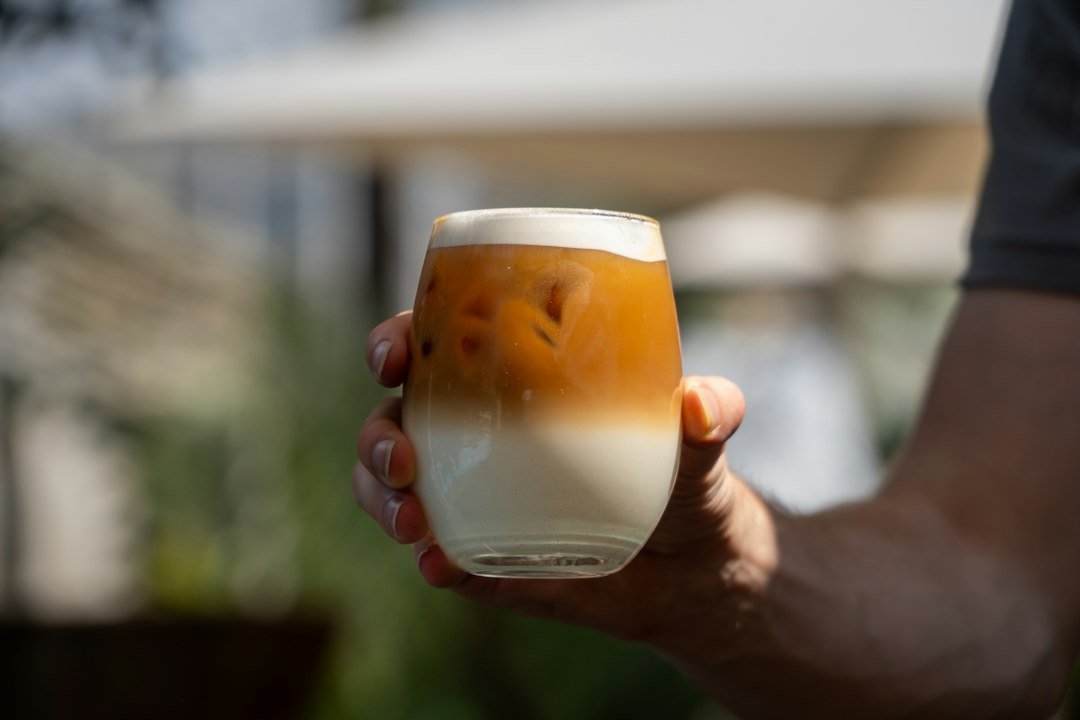
The iced latte won because it makes modern coffee life ridiculously easy.
By 2026, it sits right in the middle of how cafés build menus, train staff, and buy equipment. It sweetens well, handles milk swaps without drama, photographs nicely for the group chat, survives the walk to work, and can be ordered half-awake in an app without needing a glossary or a barista TED Talk.
That kind of flexibility matters when coffee habits are changing in public. According to National Coffee Association data reported by Daily Coffee News on September 15, 2026, 48% of U.S. adults drank specialty coffee in the past day, and 59% drank specialty coffee in the past week. Among past-day coffee drinkers, 38% had coffee outside the home, up from 36% in January and the highest level since January 2020. The biggest drink in today’s espresso lineup is also one of the easiest to order. That helps.
Why is the iced latte everywhere right now?
The iced latte is everywhere because it tastes easy, travels well, and keeps ordering simple. It gives people espresso flavor without demanding too much attention, works smoothly in cafés and apps, and fits how more people now buy coffee cold, customized, and on the move.
In 2026, cafés and home users are leaning toward drinks that are cold, repeatable, and low-friction. The iced latte fits that brief better than most espresso drinks, which is a very efficient way to become everyone’s default.
It’s also the softest landing for espresso. A straight shot asks a lot of you at 8:30 a.m. An espresso macchiato assumes you want to think about ratios before you’ve opened Slack. An iced latte gives you espresso flavor with some padding from milk and ice, so the whole thing lands gently even when the shot runs a little sharp. That makes it friendly for regular specialty drinkers and for people who just want cold coffee that still tastes like coffee.
Latte culture, meanwhile, is doing just fine despite the annual internet tradition of declaring flavored milk drinks morally suspect. Fresh Cup reported on September 23, 2026 that Tastewise data showed Gen Z interest in pumpkin spice latte up 31.6% year over year. The same piece cited Google Trends showing pumpkin spice latte search interest at its highest point since 2022. You don’t need to order a PSL to see what’s happening. Latte-style drinks still move people.
Then there’s the menu itself. Digital ordering rewards drinks people recognize instantly. “Iced latte” is clear. “Ice cafe latte” is clear too, even if it sounds like your phone got involved. A cortado or flat white often needs a little explanation; an iced latte doesn’t. The NCA survey behind that Daily Coffee News report was fielded June 8–24, 2026, using a nationally representative sample of 1,882 U.S. adults. That report also pointed to more Americans ordering by app. On a phone screen, simple drinks usually beat niche poetry.
If you want a clearer breakdown of how milk-based espresso drinks separate from one another, this guide to cappuccino, latte, and flat white differences helps explain why the latte format remains so widely appealing.
When “iced latte” stops meaning espresso
This is where the category gets slippery.
Some iced lattes are built on espresso. Some are built on cold brew concentrate because it’s faster. Both can taste good. They are different drinks.
Fresh Cup reported on October 2, 2026 that some operators are replacing espresso with cold brew concentrate in beverages that would traditionally use espresso, including iced lattes. That piece named Creature Coffee Co, a mobile cart company operating in Austin, Phoenix, Seattle, and other cities. Their carts handle events for a few dozen guests or several hundred. At that size, a line can go from charming to mutinous in about six minutes.

The reason is practical. Pulling espresso well takes attention. You have to dial in the recipe and watch the extraction while adjusting through the rush as temperature shifts. That’s normal café life. It’s also a headache when you’re trying to serve 200 people before a keynote, wedding toast, or brand activation starts. Cold brew concentrate cuts down on equipment needs and clears the bottleneck. Nobody at a conference wants a lecture on crema while the line snakes past the tote bags.
For you, this changes what the label means. If a café hands you a mix of milk, ice, plus concentrated cold coffee, the drink may still be smooth and pleasant. It may even beat a badly pulled shot. But the flavor shape changes. Espresso brings pressure extraction, crema, and a compact little punch. Cold brew concentrate brings a different sweetness and a flatter profile. Same family. Different cousin. Slightly chaotic at dinner.
For a deeper look at how cold coffee styles diverge, this comparison of cold brew and iced coffee gives useful context for why concentrate-based drinks do not taste like espresso-based ones.
Iced latte vs americano ice
The iced latte is comfort. A cold americano is exposure.
Water leaves the espresso fully visible, so the roast character, bitterness, and extraction quality all stay out in the open. If the espresso is excellent, a cold americano can be gorgeous: crisp, aromatic, and more refreshing than it gets credit for. If the espresso is average, the drink tells on itself immediately.
An iced latte is more forgiving because milk rounds the edges and adds body. That doesn’t make it lesser. It makes it useful, which is why it became the default order instead of the daily honesty test.
Home coffee tech is pushing in the same direction. Bon Appétit wrote on October 5, 2026 that super-automatic espresso machines increasingly emphasize iced drinks alongside lattes, flat whites, and americanos. The price range runs from around $500 into the thousands, which is a polite way of saying some of these machines cost rent. Bon Appétit named the De’Longhi Primadonna Aromatic and the Terra Kaffe Demi among top picks, and quoted Sur La Table’s Jenn Mudge saying espresso machines exist on a spectrum. Fair enough. On one end: ritual. On the other: please make coffee before my first Zoom.
Frequently Asked Questions
What is an ice cafe latte?
An ice cafe latte is espresso combined with cold milk and ice. Some cafés use the phrase interchangeably with iced latte, though a precise version should still be espresso-based rather than brewed coffee poured over ice.
What’s the difference between an iced latte and a cold americano?
An iced latte uses espresso, milk, and ice, while a cold americano uses espresso, water, and ice. The americano keeps coffee flavor more exposed, while the latte tastes smoother because milk softens bitterness and adds body.
Is americano ice stronger than an iced latte?
A cold americano usually tastes stronger because there is no milk muting the espresso. In caffeine terms it depends on how many shots the café uses, but in flavor terms the americano usually hits harder.
How is an espresso macchiato different from an iced latte?
An espresso macchiato is a shot of espresso with a small amount of milk foam. An iced latte has much more milk plus ice, so it is larger, colder, and much gentler on the palate.
Sources
- Why These Coffee Businesses Are Replacing Espresso With Cold Brew — https://freshcup.com/why-these-coffee-businesses-are-replacing-espresso-with-cold-brew/
- The Death of the Pumpkin Spice Latte Has Been Greatly Exaggerated — https://freshcup.com/the-death-of-the-pumpkin-spice-latte-has-been-greatly-exaggerated/
- NCA: More Americans Are Drinking Specialty Coffee and Ordering by App — https://dailycoffeenews.com/2026/09/15/nca-more-americans-are-drinking-specialty-coffee-and-ordering-by-app/
- Tempest Stirs Up Craft Coffee and Cocktails in Suburban Indianapolis — https://dailycoffeenews.com/2026/10/12/tempest-stirs-up-craft-coffee-and-cocktails-in-suburban-indianapolis/
- The Best Automatic Espresso Machines for the Easiest Morning Latte (2026) — https://www.bonappetit.com/story/best-automatic-espresso-machines
